Dearly Told
Download the complete sampleCreate an autobiography — $249
A Dearly Told Life Story

Isabel Rivera

A Place at
My Own Table

Fictional sample edition

Read a fictional sample

Your conversations become a book in your own words.

Dearly Told guides six relaxed phone conversations, then shapes the storyteller’s own words into a polished, chronological autobiography. Family photographs are woven through the chapters, and nothing is printed until the storyteller approves it.

They do
Take part in six guided phone conversations
We do
Interview, write, edit, and design
They receive
Their approved hardcover autobiography

Written in first person, with vivid language and personal reflection, this sample follows one woman's life through immigration, family hardship, and a return to her own ambitions.

Complete experience · $249
Six guided phone interviews, writing, photographs, and one hardcover. 30-day money-back guarantee from purchase.

Create an autobiography — $249

We estimate book delivery within 30 days after final manuscript and photo approval, following your interviews and photograph upload. Contact us before purchasing if a specific delivery date is essential.

This is a fictional demonstration. A fictional first-person memoir created to demonstrate Dearly Told's narrative style. Isabel Rivera, her family, events and dialogue are invented. This short sample is not customer work or a full-length commissioned book. Customer stories are shaped from the storyteller's memories and approved by them; experiences and dialogue are never invented.

From conversation to chapter

A memory doesn’t have to arrive beautifully written.

22-second fictional writing demonstration with on-screen text and original instrumental music.

Scripted fictional demonstration. Both the conversation below and Isabel’s sample memoir are invented to illustrate the process. This is not a recording, a customer interview, or evidence of a completed customer book.

01 · The conversation

Start with something ordinary.

AI interviewer
When you picture the kitchen in your childhood home, what comes back first?

Isabel · fictional storyteller
The window. It stuck when it rained. My mother would hit it with the heel of her hand to open it. Then you could hear everything outside—a vendor, the neighbor’s radio, somebody arguing with a dog.

AI interviewer
What do you remember about your father’s work?

Isabel · fictional storyteller
He repaired shoes in the front room. Leather and polish—that smell followed him to dinner even after he washed. When work was slow, he sat with his account book and moved his pencil between the columns. I knew he was worried before I understood the numbers.

02 · The written chapter

The Table by the Window

I grew up in a narrow house in Puebla, with a kitchen window that stuck during the rainy season. My mother opened it with the heel of her hand. I can still hear the sudden scrape of wood, followed by the neighborhood arriving all at once: a vendor calling from the street, a radio next door, somebody arguing with a dog.

My father repaired shoes in a room at the front. His work had a smell of leather and polish that followed him to the table, no matter how carefully he washed. When business was slow, he sat with his account book open and moved the pencil from one column to another. I understood the worry before I understood the numbers.

Excerpt from the fictional sample memoir

What changes—and what stays theirs

The spoken details become connected paragraphs. The window, neighborhood sounds, shoe repair, and account book remain the substance of the memory. Wording and flow are edited; customer events and dialogue are not invented.

How does the storyteller stay in control?

Real interviews begin only after consent through the secure portal. The storyteller can skip questions and review the written story, correct details, or remove material before approving it for printing. Private interview codes are available through the portal.

Explore the book ↓ · Read the complete fictional sample

03 · A place for their story

A book to open together.

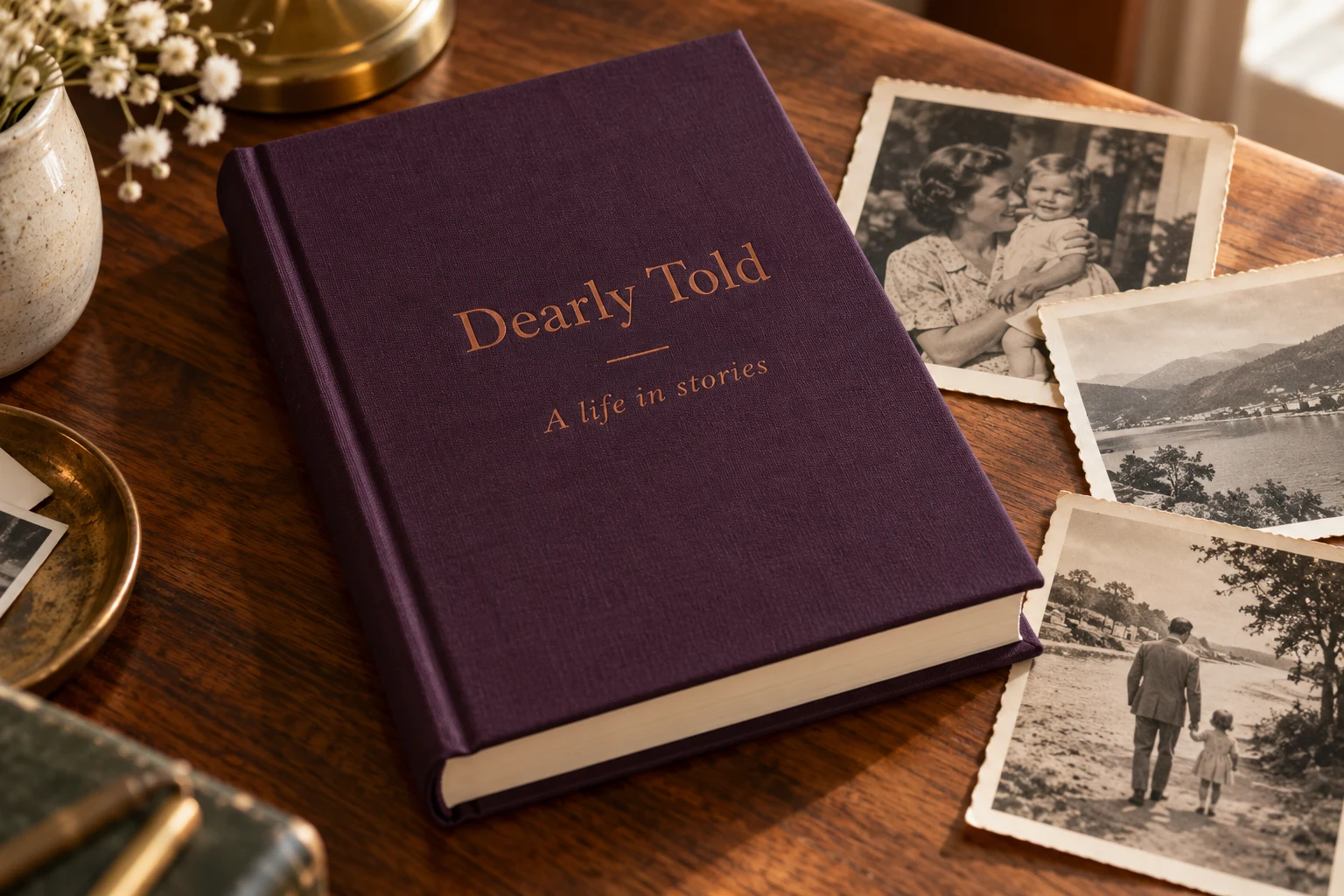
Family photographs can sit alongside the written memories. The storyteller reviews and approves the story before it moves to printing.

Dearly Told hardcover autobiography beside family photographs

Inside the book

Stories told in their voice, shaped for generations.

Prologue01

Prologue

The Name I Almost Didn't Hear

The morning my daughter graduated, I carried three safety pins in my purse, a packet of tissues, and the unreasonable fear that something would go wrong if I stopped being useful.

Lucia had asked me to hold her coat. Her father had given me the car keys. By the time we found our seats, I had everyone's belongings arranged on my lap, as if I had come to a ceremony honoring my ability to keep things from getting lost.

Then they called her name.

She crossed the stage in shoes we had bought together, the sensible pair abandoned at the last minute for heels she insisted she could manage. I watched her step carefully over a loose cable. Even then, part of me wanted to stand up and warn her. But she saw it herself. She lifted her foot, kept walking, and took her diploma.

I cried, of course. I had earned that much predictability. What surprised me was the other feeling that came with the pride: a small, sharp grief I could not explain without sounding ungrateful. I had once wanted to cross a stage like that. Long before I became someone's mother, before I learned to calculate a week's meals in the grocery aisle, I had been a girl who loved books and expected to continue her education.

Afterward, Lucia found us under a tree beside the parking lot. Her father took photographs. I straightened the collar of her gown until she caught my hand. 'Mama,' she said, 'just be in the picture.'

I stood beside her, still holding the coats. In the photograph, I am smiling. You would never guess that I was trying to remember when I had last wanted something I couldn't describe as being for my family.

To explain that morning, I have to go back to the first house I knew, where the table was too small and nobody considered that a reason to turn someone away.

Chapter One02

Chapter One

The Table by the Window

I grew up in a narrow house in Puebla, with a kitchen window that stuck during the rainy season. My mother opened it with the heel of her hand. I can still hear the sudden scrape of wood, followed by the neighborhood arriving all at once: a vendor calling from the street, a radio next door, somebody arguing with a dog.

My father repaired shoes in a room at the front. His work had a smell of leather and polish that followed him to the table, no matter how carefully he washed. When business was slow, he sat with his account book open and moved the pencil from one column to another. I understood the worry before I understood the numbers.

There were four of us children. I was the eldest daughter, which meant I was old enough to help before I was old enough to question the arrangement. I learned which pot could stretch a meal, which brother needed reminding, and how to tell from my mother's shoulders whether I should bring up a school expense that evening or wait.

I loved her. I also watched her. She ate after everyone else, standing sometimes, finishing what remained in a pan. When I asked why she didn't sit down, she said she had one more thing to do. Years later, I would hear myself giving the same answer.

At school I liked history, especially the ordinary details our textbook hurried past. Who cooked while a city was changing? What did people take with them when they left? My teacher, Señora Vega, lent me books and asked what I thought of them. She waited for an answer. I was accustomed to being asked whether I had finished something; being asked what I thought felt like being offered a chair.

I wanted to teach. I did not have a grand theory about education. I liked the idea of a room where questions were allowed, and I liked the person I became when I was reading.

Then my father's hands began to hurt. Some mornings he could barely close them around his tools. My older brother was already working, and I took a job in a clothing shop after finishing secondary school. I told Señora Vega I would return to my studies when things settled. She wrote her telephone number inside the cover of a book and told me to keep it.

I kept the book. Things did not settle in the way I had imagined.

Chapter Two03

Chapter Two

What Fit in the Suitcase

Daniel met me at the shop while buying a shirt for his sister's wedding. He asked my opinion and then purchased the other one. I mentioned this often during our marriage. He maintained that it proved he had a mind of his own; I said it proved he needed supervision.

He could make me laugh without making anyone else smaller. That mattered to me. We married in 1983, and when an opportunity came to move legally to New Jersey, where his aunt lived, we spent months discussing it as though discussing it could make the distance shorter.

Our daughter was two. We wanted steadier work, a place of our own, choices we had not known how to find at home. I was also curious. I have sometimes told this part as if I went entirely for my child. That is the respectable version. The fuller truth is that I wanted to see what else there was.

My mother helped me pack. She folded Lucia's clothes so tightly that I wondered whether she believed neatness could protect us. We argued about a heavy serving dish. I said there was no room. She said I would need something decent when people came to eat. In the end I took it, wrapped in two of my own blouses.

I left behind books, a bicycle, and people who could understand a sentence before I finished it. In my suitcase I put photographs, documents, a sweater I would discover was much too thin, and the book with my teacher's number inside.

At the airport my father gave me an envelope with money he could not comfortably spare. He told me not to open it until we arrived. I think he was embarrassed by how little it contained. I was embarrassed by how badly I needed it. We embraced without discussing either thing.

For a long time afterward, whenever I remembered leaving, I saw my mother's face. Now I also remember myself turning toward the gate. I was frightened, certainly, but I was moving. Both things were true.

Chapter Three04

Chapter Three

Learning the Rooms

Our first winter was spent in Daniel's aunt's apartment, where the radiator knocked at night like someone determined to be let in. We slept in the smaller bedroom. Lucia's mattress lay beside ours, and in the morning we folded her blankets before there was room to open the door.

I had studied some English, but the language in my schoolbook had been considerate. It introduced itself. The language on the bus hurried, swallowed its endings, and expected me to know where to get off.

One afternoon I missed my stop and stayed on because I was afraid to ask the driver a question badly. By the time I returned, Lucia was hungry and I was furious with myself. I had been competent in my own country. Here I could be defeated by a bus route.

Daniel found warehouse work. I cleaned offices after business hours. At night I emptied wastebaskets beside desks where people had left books, photographs, and half-finished cups of coffee. I used to read the notices pinned above the photocopier, sounding out unfamiliar words when nobody was there to hear me.

There were people who were patient and people who became louder when I didn't understand, as if volume could replace an explanation. I learned to nod. It was an efficient habit and a dangerous one. Sometimes I agreed to things I had not understood because I wanted the embarrassment to end.

The public library became the first place I could enter without having to buy something or explain my presence. A librarian named Ruth helped me get a card. When I apologized for my English, she asked which books I enjoyed. She spoke slowly without speaking to me like a child. I went home with three books and a leaflet for evening language classes.

We eventually rented an apartment above a laundromat. The floor trembled faintly when the machines were running. I complained about the noise, then lay awake on Sundays when the quiet felt unfamiliar. Our son, Mateo, was born there. Lucia began school. We bought a secondhand table with a pale ring on one corner that no amount of polishing removed.

I put my mother's serving dish in the middle. When she visited years later, she ran her hand over the table and asked whether the chairs were comfortable. I had prepared a speech about how far we had come. Instead I pulled one out for her.

Chapter Four05

Chapter Four

The Year of Envelopes

Daniel injured his back at work when Mateo was seven. At first we spoke of weeks. Then the weeks became appointments, forms, arguments over the telephone, and envelopes we left unopened until the children had gone to bed.

I took more cleaning work. Daniel could manage some things and not others, and neither of us was gracious about the uncertainty. He felt useless. I felt indispensable, which was not nearly as noble as it sounds. There were evenings when I used my exhaustion against him. I would list everything I had done, then wait for him to understand what the list had cost me.

He began answering less. The apartment filled with things neither of us wanted to say in front of the children. Lucia became helpful in a way I praised too quickly. She made her brother's lunch and checked his homework. I was relieved to have the help; only later did I ask myself how often she had been listening from the hallway.

One night she found me at the table, separating bills into piles. She asked whether we were going to lose the apartment. I said no with a certainty I did not possess. She nodded, but she did not go back to bed immediately. I remember the marks her socks had left around her ankles. She was still a child, standing there trying to measure a danger I would not name.

The next morning I called a community assistance office whose number Ruth had given me. I almost hung up before anyone answered. I had confused asking for help with announcing that I was no longer capable of loving my family properly. The woman who answered wanted our information, not a defense of my character. We received temporary help with food and learned which benefits Daniel could apply for.

Recovery was slow. There was no single wonderful day when we became the people we had been before. Daniel retrained for less physical work. I kept some of my extra hours. We learned to speak about money earlier in the evening, before fatigue made every question sound like an accusation.

Years afterward, I apologized to Lucia for leaning on her so heavily. She told me she had been proud to help. Then she added, very quietly, that she had also been scared. I wanted to explain everything. I made myself listen instead.

Chapter Five06

Chapter Five

A Form with My Name on It

By the time Lucia graduated from college, our life had become steadier. Daniel still had painful days, but he was working. Mateo was studying automotive technology and had begun correcting his father's opinions about engines. We could pay a bill without first moving another one beneath it.

After the ceremony, I kept returning to the feeling I had tried to hide beside the parking lot. I was happy for my daughter. I was also unhappy about something in my own life, and neither feeling canceled the other.

A few weeks later, Lucia found the old book from Señora Vega while helping me clear a cupboard. She asked why there was a telephone number written inside. I told her about school, about wanting to teach, about how I had expected the delay to be temporary. She listened and then asked whether I still wanted to study.

I said I was too old. She asked how old I would be if I didn't. It was an irritatingly good question. I told her so.

I went to the community college to ask about adult education. In the parking lot I sat for twenty minutes, rehearsing what to say. Inside, a young employee handed me a form. For once the information requested was mine: my schooling, my interests, my plans. There was no space where I could put 'whatever everyone else needs.'

The work was harder than I had allowed myself to expect. I read slowly. I worried about my accent when speaking in class. Once, after getting a poor grade, I left my books in the car for three days. Daniel brought them inside without comment and set them at my place at the table.

We had to change things at home. He cooked twice a week. Mateo learned that clean clothes did not appear by themselves. I learned to let a badly folded towel remain badly folded. Sometimes I studied while the kitchen was untidy, and the world continued in its inconsiderate way, refusing to collapse and justify my worry.

I did not become a classroom teacher. The time and cost of that path were more than I could take on. I completed an associate degree and began working as a bilingual aide in an adult learning program. At first, that smaller outcome troubled me. Then a student stayed after a lesson to ask a question she had been afraid to ask in front of the others. I pulled out a chair. We had time.

Chapter Six07

Chapter Six

Making Room

My mother died before she could see me graduate. I dislike that fact and have never found a useful way to improve it. I had sent her photographs of my classroom, and she had told the neighbors I was studying. That comforts me. It does not give me the conversation I wanted to have with her.

When I returned to Puebla, the kitchen window still stuck. My younger brother opened it with the same blow of his hand. For a moment I expected to hear her tell him to be careful. We sorted her belongings over several days, making decisions that felt too final for objects as ordinary as a saucepan or a pair of shoes.

I found a photograph of her as a young woman. She was standing beside a cousin, laughing at something beyond the frame. I could not remember seeing her laugh quite that way. I brought the photograph home because I wanted to keep meeting parts of her that had existed before I needed her.

Now I am sixty-eight. Daniel and I still argue about how much a shirt ought to cost. He walks carefully on cold mornings, and I pretend not to watch him until he tells me to stop. Our children have lives that do not require us in the same ways. I miss being needed sometimes. I also enjoy reading an entire chapter without getting up.

At the learning center, I recognize the woman who apologizes before beginning a sentence. I try not to finish it for her. Patience is easier to admire than to practice, especially when you think you already know what someone means.

I still have the table from the apartment above the laundromat. The chairs have been replaced, and the pale ring has darkened. There are scratches from homework, a small burn Daniel denies causing, and a mark underneath where Mateo wrote his name when he was supposed to be doing something else. My mother's dish comes out when everyone visits.

For years, I thought a good life would leave very little evidence of wanting anything for myself. I am sorry for some of what that taught my daughter. I hope other things taught her differently: the form I filled out, the books I brought back into the house, the evenings when someone else made dinner.

Last Sunday, Lucia arrived with her little boy while I was reading at the table. She asked whether I wanted help with lunch. I nearly said I had it all under control. Instead I handed her the onions and moved my book to the end where the afternoon light falls.

We talked while she chopped. Her son climbed onto my lap with a book of his own. He wanted me to read it, and I did. When we finished, he slid down to find his mother. I watched him go, then opened my book again at the page I had marked.
The complete experience

Six conversations.
Your photographs.
Your autobiography.

Your autobiography, made simple

Give the question.
They give your family their story.

The complete Dearly Told autobiography experience is $249. 30-day money-back guarantee from purchase.

Create an autobiography — $249Return to Dearly Told